Facebook Ad Sizes (2026): Every Meta Spec
Facebook ad sizes in 2026 come down to three: 1440 x 1800 (4:5) for Facebook and Instagram feeds, 1440 x 2560 (9:16) for Stories and Reels, and 1080 x 1080 (1:1) for carousels. Those are the resolutions Meta's own Ads Guide recommends today. Videos can be MP4 or MOV up to 4 GB, and images JPG or PNG up to 30 MB.
TL;DR
Feed (Facebook and Instagram): 4:5, 1440 x 1800 recommended. 1080 x 1350 is the same shape and works fine.
Stories and Reels: 9:16, 1440 x 2560 recommended. Keep text out of the top 14%, bottom 35% and 6% on each side.
Carousel: 1:1, at least 1080 x 1080, 2 to 10 cards.
TikTok: 9:16. TikTok's help pages list at least 540 x 960 and up to 500 MB for In-Feed ads, but its own pages disagree on maximum length. Details below.
Where UGCdrop fits
Most UGC ads today are vertical video, so the size that matters most is 9:16. UGCdrop's Studio builds ads on a 1080 x 1920 vertical frame and places hook text inside the safe zone, so captions don't end up under the like button or the call to action. The library has 3,600+ real creator clips, from $0.50 per clip.
It won't make your static image ads or carousels. For those, use this guide and your design tool.
The 3 sizes that cover almost every Meta placement
Meta's aspect ratio guidance is simple: feeds support 1:1 and 4:5, and Stories, Status and Reels should be 9:16 because people hold their phones vertically. In-stream video is the exception, at 16:9.
| Asset | Ratio | Meta's recommended size | Common smaller size | Where it runs |
|---|---|---|---|---|
| Vertical full screen | 9:16 | 1440 x 2560 | 1080 x 1920 | Facebook and Instagram Stories, Reels, Audience Network |
| Vertical feed | 4:5 | 1440 x 1800 | 1080 x 1350 | Facebook Feed, Instagram feed |
| Square | 1:1 | At least 1080 x 1080 | 1080 x 1080 | Carousels, feeds |
Upload one 9:16 and one 4:5 version of each ad and you cover the placements that get most of the spend. If you only upload one, Meta fills the gaps itself with padding, cropping, media expansion and AI tools, according to the same help article. Check those auto-crops before you publish.
Facebook and Instagram video ad specs by placement
Every number below comes from the Meta Ads Guide, checked on October 30, 2026.
| Placement | Ratio | Recommended resolution | Length | Notes |
|---|---|---|---|---|
| Facebook Feed | 4:5 | 1440 x 1800 | 1 second to 241 minutes | Min 120 x 120 px |
| Instagram feed | 9:16 (as listed) | 1080 x 1920 | 1 second to 60 minutes | Min width 250 px, 1% ratio tolerance |
| Facebook Stories | 9:16 | 1440 x 2560 | 1 second to 3 minutes | Over 15 seconds is split into cards |
| Instagram Stories | 9:16 | 1440 x 2560 | 1 second to 60 minutes | 16 seconds or longer may be split into cards |
| Facebook Reels | 9:16 | 1440 x 2560 | No maximum listed | Safe zone 14% / 35% / 6% |
| Instagram Reels | 9:16 | 1440 x 2560 | 0 seconds to 15 minutes | Min width 250 px (500 px for 30 seconds or longer) |
For every video placement: MP4 or MOV, maximum 4 GB, H.264 compression, square pixels, fixed frame rate, progressive scan, and stereo AAC audio at 128 kbps or more. Captions and sound are optional but recommended. Meta "strongly" recommends sound for Reels.
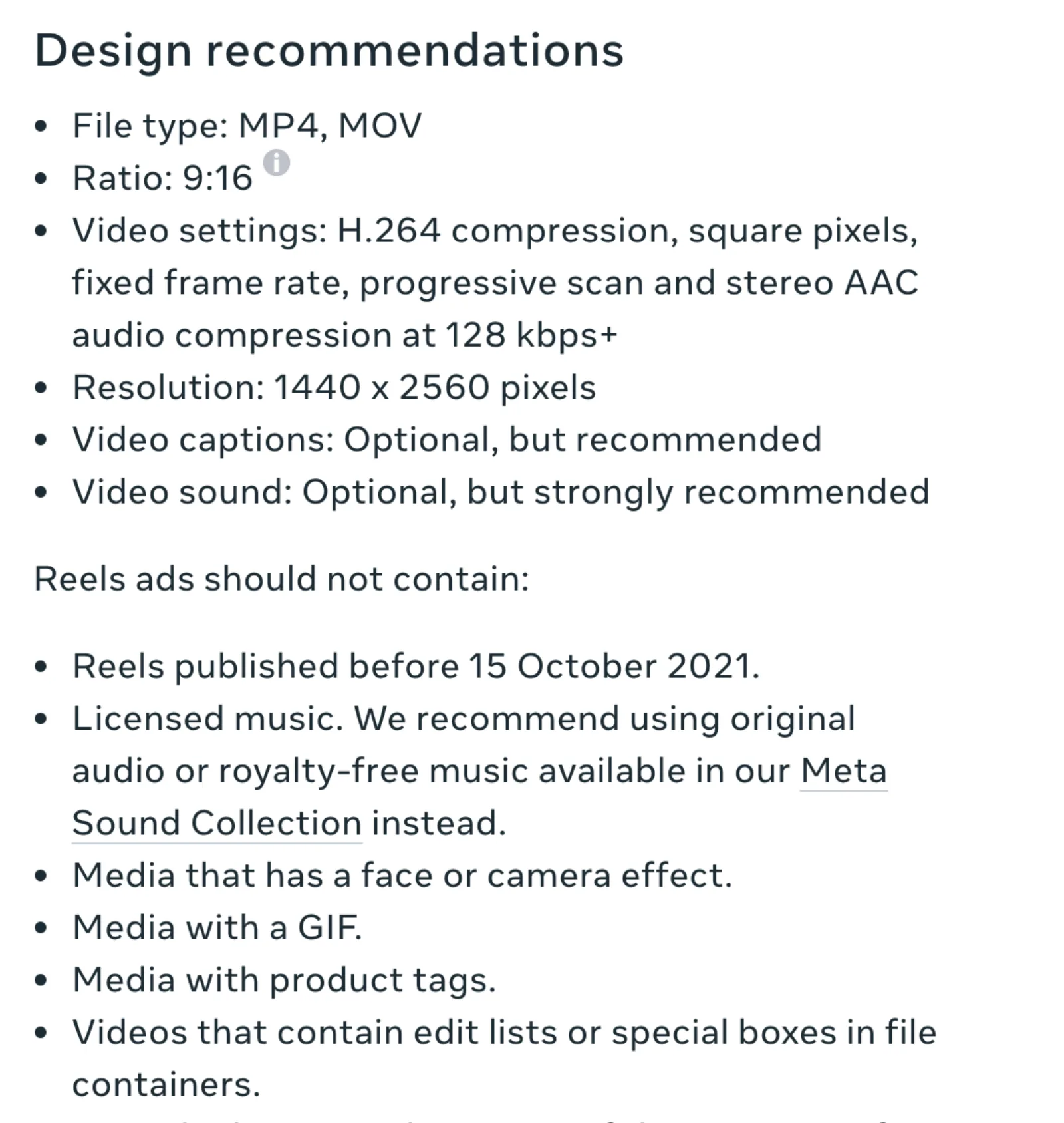
Reels have extra rules. The Instagram Reels page says Reels ads should not contain licensed music (use original audio or Meta's Sound Collection), face or camera effects, GIFs, product tags, or edit lists in the file container. If your Reels ad gets rejected or won't deliver to Reels, check these first.
Where Meta's own docs disagree: the Instagram feed video page lists 9:16 at 1080 x 1920, while Meta's aspect ratio help article says feeds support 1:1 and 4:5. 4:5 is the safer choice for feed, because both pages accept it. Whatever you upload, check the feed preview in Ads Manager.
Facebook and Instagram image ad sizes
From the Meta Ads Guide image section:
| Placement | Ratio | Recommended size | Limits |
|---|---|---|---|
| Facebook Feed | 4:5 | 1440 x 1800 | Max 30 MB, min height 750 px at 4:5, 3% tolerance |
| Instagram feed | 4:5 | 1440 x 1800 | Max 30 MB, min width 500 px, ratios from 1.91:1 to 4:5 |
| Facebook Stories | 9:16 | 1440 x 2560 | JPG or PNG, max 30 MB, min width 500 px |
| Instagram Stories | 9:16 | 1440 x 2560 | Max 30 MB, min width 500 px |
| Instagram Reels | 9:16 | 1440 x 2560 | JPG or PNG, max 30 MB, min width 500 px |
| Carousel | 1:1 | At least 1080 x 1080 | 2 to 10 cards, images 30 MB, videos 4 GB |
One more conflict to know about: Meta's aspect ratio help article recommends 1:1 for single-image ads in the Instagram feed and 4:5 for Facebook Feed, while the Ads Guide lists 4:5 for both. Both are accepted. We'd use 4:5, because it takes up more of the screen.
1440 or 1080? What to export
Meta now recommends 1440 x 1800 and 1440 x 2560. Most third-party guides, editors and templates still use 1080 x 1350 and 1080 x 1920. Both have the same shape, and 1080 is far above Meta's minimums.
Simonas, UGCdrop's founder, has run UGC ads on Meta and TikTok for four years. What he exports is simple: 1080p at 24 or 30 frames per second. Nothing fancy, and no HDR, because social platforms compress the video anyway. A phone-shot UGC ad doesn't gain much from extra pixels.
Our rule of thumb:
UGC and phone footage: export 1080 x 1920 or 1080 x 1350, 24 or 30 fps, SDR, H.264, AAC audio.
Designed graphics or text-heavy statics: export at Meta's 1440 size so small text stays sharp.
Never upscale. Turning 1080 footage into 1440 adds file size, not detail.
Need to convert a file? Our free tools can resize or crop a video to 9:16, 4:5 or 1:1, convert MOV to MP4 and compress a video under the limit.
Safe zones for Stories and Reels
On every 9:16 placement, Meta says to keep roughly the top 14%, the bottom 35% and 6% on each side free of text, logos and key elements, so they aren't cropped or covered by the profile icon or call to action. In pixels:
| Frame | Top (14%) | Bottom (35%) | Each side (6%) | Safe area left |
|---|---|---|---|---|
| 1080 x 1920 | 269 px | 672 px | 65 px | 950 x 979 px |
| 1440 x 2560 | 358 px | 896 px | 86 px | 1268 x 1306 px |
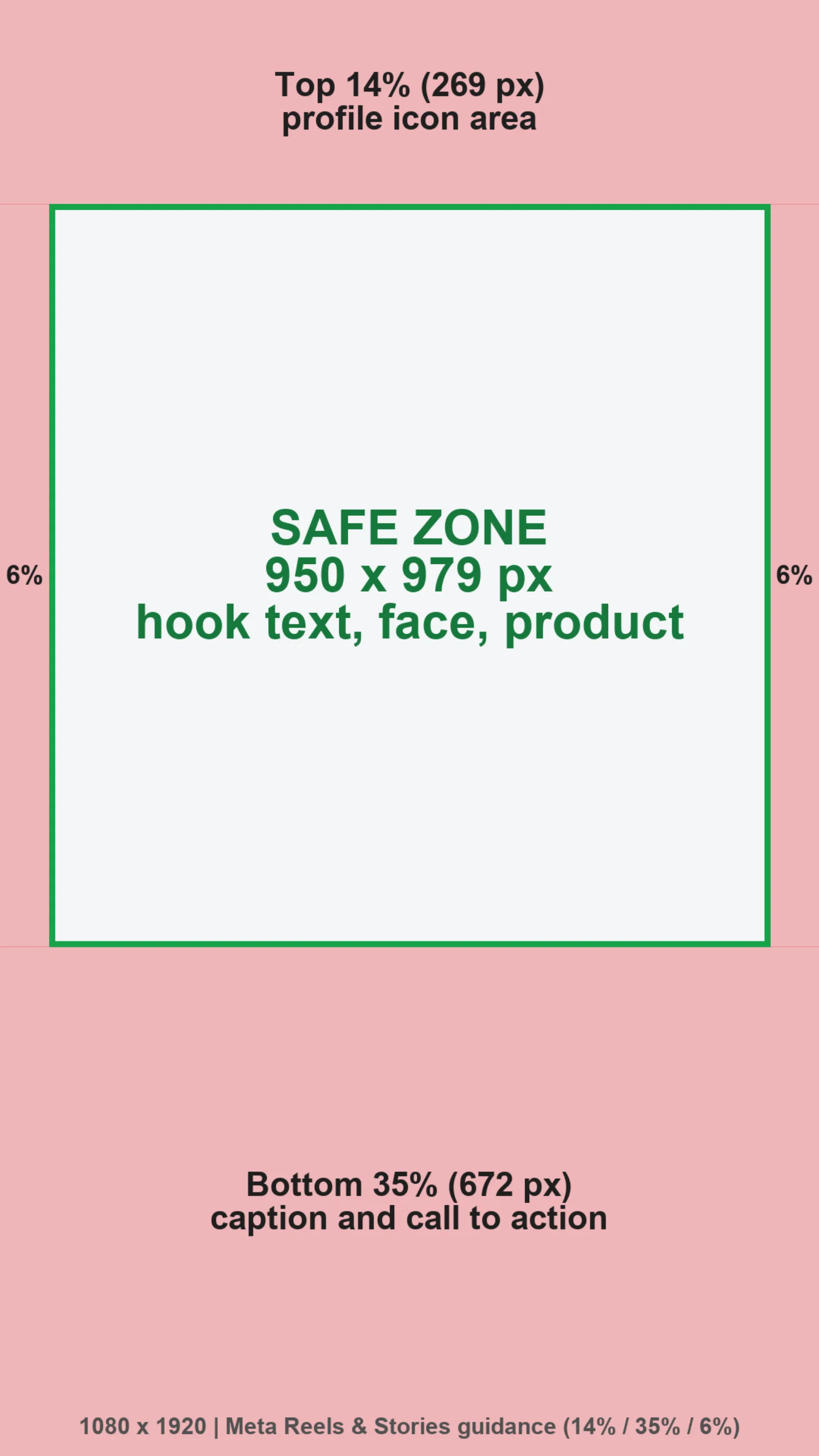
The bottom 35% is the zone people forget. That's where the caption, the call-to-action button and the account name sit. Put your hook text in the upper half of the safe area, and keep the creator's face in the middle of the frame. Simonas sees two mistakes more than any others: text that's too big, and the main subject placed off-center so the viewer's eye jumps around.
TikTok ad specs
A caveat first: we couldn't load TikTok's ads help center live when writing this, so these numbers come from TikTok's indexed help pages, and TikTok's own pages don't fully agree. Check the preview in TikTok Ads Manager before you export a batch.
| Spec | What TikTok's help pages say |
|---|---|
| Ratio | 9:16 vertical recommended. The ad format policy also lists 1:1 and 16:9. |
| Resolution | At least 540 x 960 for Auction In-Feed ads. Some formats (for example App Bundle) ask for 720 x 1280 or higher. |
| File size | 500 MB or less for In-Feed ads |
| Bitrate | At least 516 kbps |
| Length | The In-Feed ads page allows up to 10 minutes. The ad format policy page says 5 to 60 seconds. They conflict. |
| Safe zone | TikTok publishes downloadable safe-zone overlays instead of pixel numbers. The safe area shrinks as the ad caption gets longer. |
Sources: TikTok Auction In-Feed Ads, TikTok ad format policy.
In practice, the same 1080 x 1920 file works on TikTok, Reels and Stories. Keep it under 60 seconds and you stay inside the stricter of TikTok's two length rules. Most UGC ads that work are far shorter than that anyway. For more on what to put in the frame, see UGC for TikTok ads.
Cheat sheet: one ad, every placement
| Platform and placement | Export | Keep clear |
|---|---|---|
| Facebook and Instagram Reels and Stories | 9:16, 1080 x 1920 (or 1440 x 2560) | Top 14%, bottom 35%, sides 6% |
| Facebook and Instagram feed | 4:5, 1080 x 1350 (or 1440 x 1800) | Keep text away from the edges |
| Carousel cards | 1:1, 1080 x 1080 | Same ratio on every card |
| TikTok In-Feed | 9:16, 1080 x 1920, under 60 seconds, under 500 MB | Use TikTok's overlay, shorter captions |
| Facebook in-stream | 16:9 | Not a UGC placement |
When automatic placements are enough
If you're testing hooks, one 9:16 video is enough. Let Advantage+ placements spread it, check the auto-generated crops, and spend your time on more hooks instead of more sizes. Sizing rarely makes or breaks an ad. The first three seconds do.
Make dedicated versions when a placement starts getting real spend. A winner in Reels deserves a clean 4:5 cut for feed, with the hook text moved up, instead of a center crop that cuts off the creator's face.
And if you run static image ads or catalog carousels, Meta's auto-adjustments matter more. Supply every ratio yourself.
How to make a correctly sized UGC ad in UGCdrop
Pick a hook clip. Browse the library, filter to Real for real creators, and choose a reaction or talking-to-camera clip. Clips are vertical, so they fit 9:16 placements with no cropping.
Add your hook text. Type your own line in Studio. It sits inside the safe zone by default, above the 35% bottom area.
Add your demo and music. Studio's steps are Hooks, Library, Demos, Music. Keep the demo to one to three steps with a clear result.
Render and download. Rendering is free. Only downloads use credits. You get a 9:16 file ready for Reels, Stories and TikTok.
Make a 4:5 cut for feed if it wins. Use the resize tool and check the face and text stay in frame.
More on running UGC on Meta: UGC for Meta ads. Cheap clips for testing: UGC stock videos.
FAQ
What are the 3 recommended sizes for Meta ads?
9:16 (1440 x 2560) for Stories and Reels, 4:5 (1440 x 1800) for Facebook and Instagram feeds, and 1:1 (at least 1080 x 1080) for carousels. Those cover almost every placement.
Is 1080x1350 good for Facebook?
Yes. 1080 x 1350 is a 4:5 ratio, the same shape Meta recommends for Facebook Feed. Meta's listed size is 1440 x 1800, but 1080 x 1350 is well above the minimum and looks the same on a phone.
What is the best Facebook video size in 2026?
9:16 at 1080 x 1920 or 1440 x 2560 for Reels and Stories, and 4:5 at 1080 x 1350 or 1440 x 1800 for feed. Use MP4 or MOV with H.264 video and AAC audio, under 4 GB.
What is the Facebook ad image size?
1440 x 1800 (4:5) for Facebook Feed, 1440 x 2560 (9:16) for Stories, and at least 1080 x 1080 (1:1) for carousel cards. Images can be JPG or PNG up to 30 MB.
What are the Instagram ad sizes?
Instagram feed: 4:5 at 1440 x 1800. Instagram Stories and Reels: 9:16 at 1440 x 2560. Note that Meta's Instagram feed video page lists 9:16 at 1080 x 1920, so preview feed placements before launch.
How long can a Facebook video ad be?
It depends on the placement: up to 241 minutes in Facebook Feed, 3 minutes in Facebook Stories, 15 minutes in Instagram Reels and 60 minutes in Instagram Stories. Short is still better. Stories split videos longer than about 15 seconds into cards.
What are the TikTok ad specs?
9:16 vertical, at least 540 x 960 (1080 x 1920 is standard), under 500 MB. TikTok's pages disagree on length: up to 10 minutes on the In-Feed page, 5 to 60 seconds in the ad format policy. Staying under 60 seconds satisfies both.
Bottom line
You need three sizes: 9:16 for Stories and Reels, 4:5 for feeds, and 1:1 for carousels. Meta recommends 1440-pixel versions, but 1080 x 1920 and 1080 x 1350 work fine for phone-shot UGC, and that's what Simonas exports: 1080p, 24 or 30 fps, no HDR. Keep text out of the top 14% and bottom 35%, and the same vertical file will run on Reels, Stories and TikTok.
Browse 3,600+ real creator clips · Build a 9:16 ad in Studio · See pricing