Top 7 UGC Rate Models for Creator Partnerships
You run a brand and need authentic video content. You've seen the stats: 79% of consumers say UGC influences their buying decisions. But when you start shopping for creators, the pricing feels like a maze. Some charge $75 per video. Others ask $750. And that's before usage rights or rush fees.
We're here to clear that up. This article breaks down the seven most common ways brands and creators set UGC rates. You'll learn how each model works, when it makes sense, and how to avoid the hidden costs that eat your budget. Whether you're a marketer planning a campaign or a creator building your rate card, these structures are the ones you'll see in 2026.
Let's get into it.
- 1. Fixed Fee per Post , Predictable Costs
- 2. Revenue Share Model , Performance-Based
- 3. Flat Monthly Retainer , Ongoing Partnerships
- 4. Usage-Based Licensing , Pay Per Use
- 5. Tiered Pricing by Platform or Follower Count
- 6. Hourly Rate , Short-Term Projects
- 7. Free Product + Exposure , Barter Arrangements
1. Fixed Fee per Post , Predictable Costs
This is the simplest model. You pay one flat rate for one piece of content. A 30-second video costs $200. A product photo costs $80. No surprises. The creator handles shooting, editing, and basic revisions. You get a final file ready for organic social or ads.
Most UGC creators quote fixed fees because they're easy to budget. , the average rate for a single video in 2025 fell between $150 and $212. The median sat around $175. But those numbers shift based on experience. Beginners might charge $50 to $100 per video. Pros with strong portfolios can command $300 or more.
Fixed fees shine when you need a quick test or a single asset. Say you're launching a new product and want five short videos for different hooks. You can find creators, agree on a per-video rate, and order them without committing to a long-term partnership. Each video is its own project.
The catch? Usage rights are often separate. Many creators include a basic organic usage license for a few months in the base fee. But if you want to run paid ads, use the content on your website, or extend the term, that's an upsell. Usage rights can add 30% to 50% of the base rate. So a $200 video might actually cost $300 if you need ad rights for six months.
Another hidden cost: revisions. Most fixed-fee packages include one or two rounds of small tweaks. Major changes or complete reshoots are extra. Ask upfront what "revision" means. Some creators charge $50 per additional round. That's fair. Just know it before you start.
When to use fixed fees: You have a clear brief and need a small batch of content fast. You don't want to track hours or split revenue. It's the easiest model for one-off collaborations.
Watch out for: Scope creep. If you keep asking for new angles or extra clips, the creator will eventually ask for more money. Respect the agreed scope or adjust the fee.
Platforms like UGCdrop use a credit-based system that works like fixed fees but with more flexibility. You buy credits and spend them on individual videos. No subscription, no commitments. That's a smart middle ground for brands that want predictability without a retainer.
2. Revenue Share Model , Performance-Based
Revenue share flips the script. Instead of paying upfront, you give the creator a percentage of sales generated by the content. This model ties earnings directly to performance. If the video bombs, the creator earns less. If it goes viral and drives thousands of orders, they earn more.
Revenue share is most common in affiliate marketing and platform-based creator economies. For example, some game platforms like Roblox let creators earn a cut of item sales. But for UGC videos used in brand ads, revenue share is rare for one reason: tracking. It's hard to attribute a sale to a single video when the customer journey involves multiple touchpoints. Most brands use revenue share only when the creator also posts on their own account with a trackable link.
Still, it's worth understanding because some creator marketplaces experiment with it. According to a LinkedIn post analyzing Roblox's progressive revenue share, creators can earn up to 70% on items priced higher than the floor. But most creators stick to the floor price to keep sales volume up, earning only 30%. That dynamic shows the tension in revenue share: higher creator cut often means higher price, which can lower volume.
When to use revenue share: You have a performance marketing setup with clear tracking. The creator posts on their own page or uses a discount code. You can measure sales or leads from that specific content. It's also useful for evergreen content that will drive sales over months.
Watch out for: Low upfront commitment. Creators may not prioritize your content if they need to wait for sales to get paid. Combine a small base fee with a performance bonus to keep them motivated.
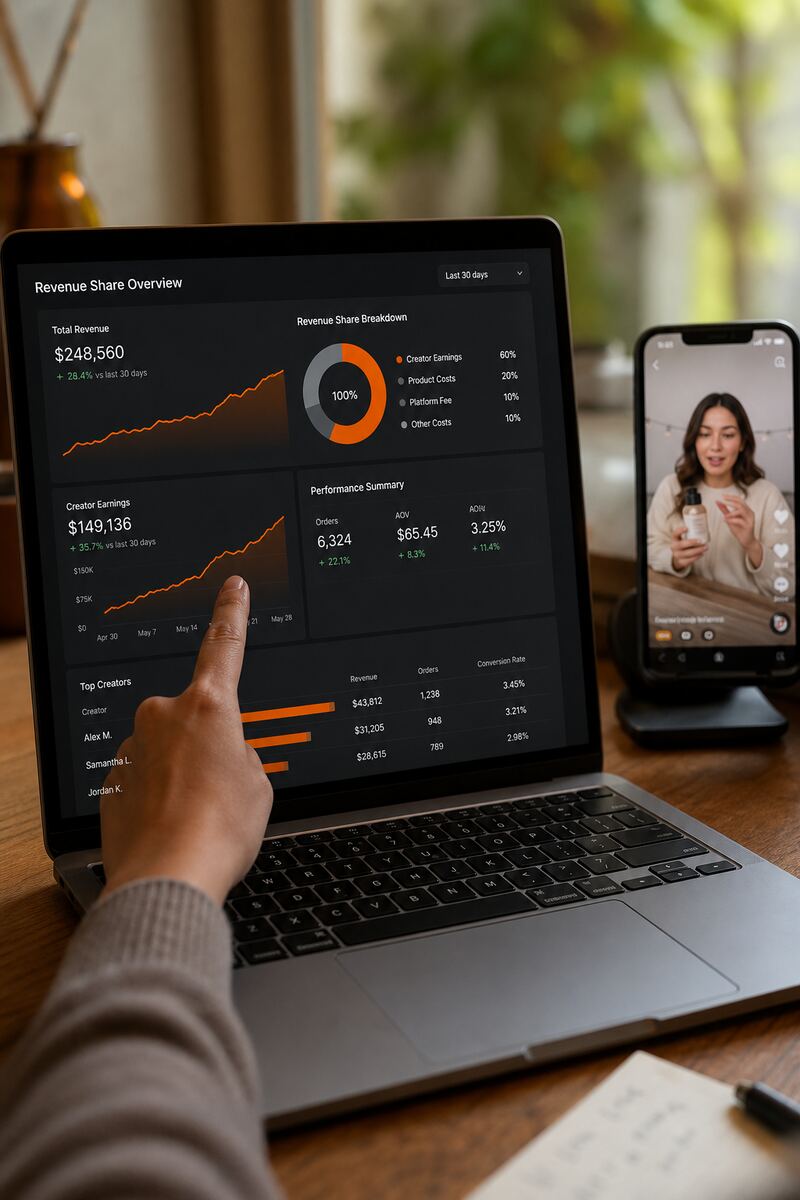
If you want performance without the tracking headache, consider usage-based licensing (see section 4). It rewards creators when their content is used, not when it sells.
3. Flat Monthly Retainer , Ongoing Partnerships
A retainer means you pay a fixed monthly fee to reserve a creator's time. They produce a set number of videos per month, often 4 to 8. This model is perfect when you need consistent content for social media or ad testing.
to monthly UGC retainers, the biggest benefit is consistency. The creator learns your brand voice, product details, and approval process over time. Each video becomes better. You also reduce administrative overhead: one contract, one invoice, one relationship to manage.
Typical retainer fees range from $1,000 to $5,000 per month, depending on the creator's experience and volume. Some creators offer discounted rates for retainers compared to one-off fees. For example, if a creator charges $250 per single video, a retainer of $800 per month for 4 videos works out to $200 each , a 20% saving.
The risk? You might pay for "access" without clear output. If the creator becomes slow or the content quality drops, you're locked in for the month. Mitigate this with a trial period and a clause that lets you pause with 30 days' notice.
Another pitfall: usage rights. Retainers often include basic organic usage for the month. But if you want to run paid ads with the content, clarify that separately. Some creators charge extra for ad usage even within a retainer.
When to use retainers: You run a brand that posts daily on social media. You need fresh creatives for A/B testing every week. You want a creator who feels like part of your team.
Watch out for: Scope creep defined verbally. Write down exactly how many videos, which platforms, revision limits, and usage terms. A good retainer agreement covers all that.
Here's a quick comparison table of retainer vs. one-off pricing:
Platforms like UGCdrop let you skip the retainer entirely. You buy credits and download clips as needed. That's faster than negotiating a retainer for a single video.
4. Usage-Based Licensing , Pay Per Use
Usage-based licensing separates content creation from content usage. You pay a base fee to create the video. Then you pay an additional license fee based on how you use it. For example, a $250 creation fee plus a $50 monthly fee for running it as a paid ad.
This model is smart because it aligns cost with value. A video that runs on a website for a year is worth more than one that appears in an Instagram Story for 24 hours. As Pitchbrand's usage rights guide explains, usage fees typically range from 20% to 30% of the base rate per month, depending on the channel. Paid ads cost more than organic social. Email marketing sits in the middle.
Here's an example from that guide: a creator charges $150 base rate. The brand wants paid ad usage for 3 months. At 25% per month, that's $37.50 per month, or $112.50 total. So the total project fee becomes $262.50 , a 75% increase over the base. The creator earns more, and the brand pays only for the time the content is actually active.
The challenge: tracking usage. You need to know when the brand stops using the content. Many brands ignore the license and use videos forever. That's why creators often charge a flat license for a set period (e.g., 12 months) rather than a recurring monthly fee. It's simpler to enforce.

When to use usage-based licensing: You plan to run the same video for months across multiple channels. You want to pay less for short-term tests and more for evergreen assets. It's fair for both sides.
Watch out for: Ambiguity in the contract. Always specify the license duration, platforms, and whether paid ads are included. A simple sentence can save you from a dispute later.
If you want a simpler model where usage rights are transparent, check out platforms like soona UGC. According to our research, soona UGC is the only platform that explicitly guarantees full usage rights in its pricing. That's rare.
5. Tiered Pricing by Platform or Follower Count
Some creators charge different rates depending on where the content will appear or how large their audience is. A video for TikTok might cost less than one for YouTube because editing effort differs. Similarly, a creator with 100,000 followers charges more than one with 5,000.
Tiered pricing tries to reflect the reach and production value of each platform. As Billo's comparison of Instagram and TikTok shows, TikTok videos tend to be shorter, less polished, and more viral. Instagram Reels demand higher production quality and storytelling. So it makes sense that Instagram content costs more to produce.
Follower-based tiering is more controversial. Many creators argue that follower count doesn't equal content quality. A nano influencer with 2,000 engaged followers can produce a better testimonial than a macro influencer with 50,000 passive followers. Yet brands often use follower count as a proxy for reach. The result: creators with small but passionate audiences undercharge, while big accounts overcharge for mediocre work.
If you use tiered pricing, base it on deliverables, not just followers. For example:
- Bronze: 1 TikTok video, organic usage, no edits , $100
- Silver: 1 Instagram Reel, basic editing, 3 revisions , $200
- Gold: 1 YouTube short, full production, 5 revisions, 6 months paid ad usage , $500
That way, the brand gets clarity, and the creator gets paid for effort.
When to use tiered pricing: You work with many creators and want to standardize rates. Or you're a creator who wants to offer packages.
Watch out for: Don't let follower count override quality. A creator with 100,000 followers but 1% engagement is less valuable than one with 10,000 followers and 15% engagement. Consider engagement rate as a factor.
Platforms like UGCdrop filter videos by categories and tags, so you can find content that matches your needs without worrying about the creator's follower count. You pay per clip, not per influence.
6. Hourly Rate , Short-Term Projects
Hourly rates are less common in UGC, but they appear for short-term or unpredictable projects. For example, you might hire a creator for a day of filming at an event, or for consulting on a content strategy. Rates range from $50 to $150 per hour depending on experience.
, hourly pricing works best when the scope is unclear. If you don't know how many videos you'll need or what the project will involve, an hourly rate protects the creator from scope creep. The brand pays only for actual time spent.
But hourly rates can discourage efficiency. A creator who takes five hours to edit a simple video earns more than one who finishes in two hours. That's why many creators set a minimum number of hours (e.g., 2-hour minimum) and switch to project-based pricing for predictable work.
When to use hourly rates: You need a creator for a specific event, a one-time brainstorming session, or a complex edit that involves lots of back-and-forth. Also useful for retainer top-ups: if you need extra videos beyond the monthly cap, pay hourly.
Watch out for: Time tracking disputes. Agree on a time log method (e.g., Toggl or manual timesheet) and cap the hours before starting. Always get prior approval for extra time.
If you're a creator, calculate your hourly rate based on your desired annual income. For example, $60,000 per year with 1,500 billable hours equals $40 per hour. Add a buffer for admin and downtime. Most UGC creators charge $50 to $100 per hour.
For brands, hourly rates are best kept to small, defined tasks. For ongoing content needs, a project-based fixed fee or retainer will save you money and headaches.
Browse UGCdrop's video library to see how credit-based pricing eliminates hourly tracking entirely. You pay per clip, not per hour of production.
7. Free Product + Exposure , Barter Arrangements
Barter means no money changes hands. The brand gives the creator free product or service in exchange for content. It's common for nano creators or when launching a new product. The creator gets something they value (makeup, gadgets, travel), and the brand gets authentic photos and videos.
According to Barter's platform, this model works best for small businesses and local brands. You list a deal, creators apply, and you choose who to collaborate with. No upfront costs. The risk is that if the product value is low, creators may not be motivated to produce high-quality content.
Exposure is a tricky term. Promising "exposure" is often a red flag. But for a creator just starting out, getting featured on a brand's social media can build their portfolio. Combined with a free product, it's sometimes enough.
When to use barter: You have a product that creators genuinely want. You have a limited budget. You're willing to accept content that may not be polished.
Watch out for: Over-reliance on barter. Many creators have learned that exposure doesn't pay bills. If the product is cheap or the brand's reach is small, you'll get low-quality content or no content at all. Consider offering a small cash payment plus product to show you value their time.
For brands that need reliable, high-quality UGC without negotiation, barter often falls short. That's why services like UGCdrop provide pre-shot clips you can download instantly. No barter, no free products, just pay per clip.
Speaking of barter, if you run events or need physical installations, services like GuavaBooth provide photo booths that generate authentic attendee content. That's another form of barter: you pay for the booth, but the resulting user-generated photos are valuable marketing material.
Key Takeaway: Barter arrangements work best when both sides see clear value. If the product is low-cost or the brand's audience is tiny, skip barter and charge a small fee instead.
Frequently Asked Questions
What is the average UGC rate in 2026?
Based on industry benchmarks, the average rate for a single UGC video in 2026 ranges from $150 to $212. The median is around $175. However, rates vary widely by creator experience, content complexity, and usage rights. Bundles of five or more videos often get a 19% discount, bringing the per-video cost down to about $162.
How do usage rights affect UGC rates?
Usage rights are a separate charge, typically 30% to 50% of the base rate. Organic social usage for 3 to 6 months is often included. Paid advertising, website use, and longer terms cost extra. Always get usage terms in writing to avoid surprises.
What's the difference between UGC rates and influencer rates?
UGC rates focus on content production , filming, editing, and delivering assets. Influencer rates are based on audience reach and engagement. UGC creators don't need a large following; they need video skills. Influencer rates are often higher because they include the cost of access to their audience.
Which UGC rate model is best for small businesses?
Fixed fee per post is the simplest for small businesses with limited budgets. It offers predictable costs and no tracking complexity. If you need ongoing content, a flat monthly retainer can be more cost-effective per video. For startups, barter arrangements can work if your product is desirable.
How should a beginner UGC creator set their rates?
Beginner creators can start around $50 to $100 per video to build a portfolio. As they gain experience and positive results, they should increase rates gradually. Offer bundle discounts and learn to negotiate usage rights , that's where the real money lies.
Can UGC rates be negotiated?
Yes, most creators expect negotiation. Instead of lowering the rate, adjust scope: reduce the number of videos, shorten usage terms, or waive extras. Be professional and suggest options. A win-win deal builds long-term relationships.
What hidden costs should brands watch for in UGC partnerships?
Common hidden costs include rush fees (25% to 50% extra), additional revision rounds ($50 each), usage rights upsells, raw footage fees, and scriptwriting charges. Always request a full quote that itemizes everything before starting.
How do platform credits like UGCdrop compare to traditional UGC rates?
UGCdrop's credit-based pricing avoids subscription fees and long-term commitments. You pay per clip with transparent pricing. No negotiation, no usage right surprises. This is often cheaper than hiring a creator for a one-off video, especially when you need multiple clips quickly.
Conclusion
Choosing the right UGC rate model depends on your campaign goals, budget, and how often you need content. Flat fees are best for one-offs. Retainers keep you consistent. Revenue share aligns incentives but requires tracking. Usage-based licensing rewards creators when their content works. Tiered pricing works for standardizing multiple creators. Hourly rates fit short tasks. And barter is good for tight budgets, but don't overuse it.
Here's the bottom line: most brands overspend on UGC because they don't plan their usage rights or they choose the wrong model. A single video with full perpetual rights can cost 2x more than a video with limited usage. Know your needs before you negotiate.
If you want the fastest, simplest path to authentic video content, check out UGCdrop's pricing page. No meetings, no contracts. Just browse clips, buy credits, and download. That's how UGC should work.