Best UGC Ad Hooks for E-Commerce (2026): 50+ Examples That Convert
- A hook is the first 2–3 seconds of a UGC ad. It's the single highest-leverage element — you lose 80% of viewers who don't engage immediately.
- The best-performing hooks fall into 5 categories: curiosity, pain point, news/discovery, dream/goal, and social proof.
- Test at least 3 hook variations per video concept. Top teams test 10+ per body concept to find their winning formula.
On TikTok and Meta, you don't get the luxury of a slow build-up. Viewers decide in the first 2–3 seconds whether they're watching or scrolling. That opening moment — the hook — determines whether everything else you've built gets seen or skipped. This guide covers the five proven hook categories for UGC ads, with 50+ ready-to-use examples and a testing framework for finding your winners fast.
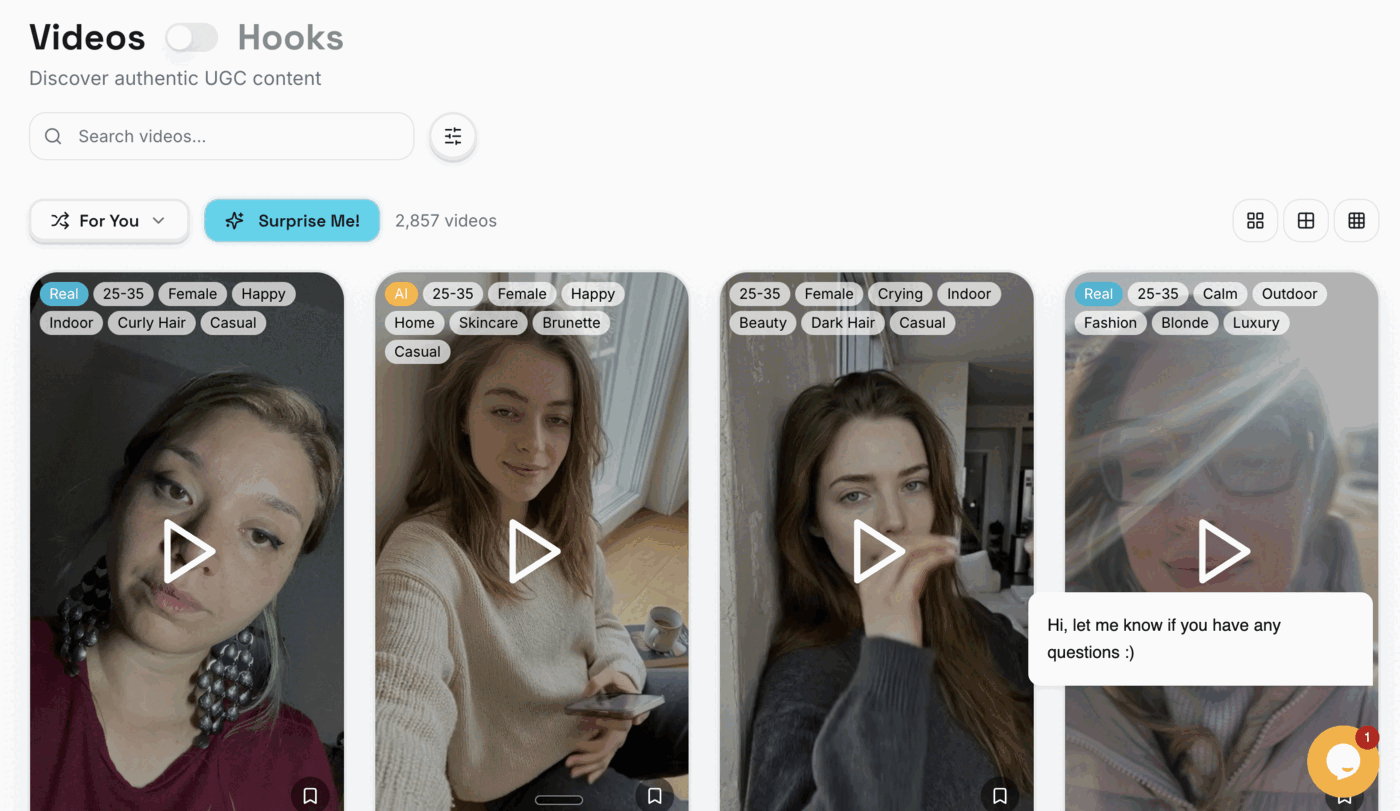
What is a UGC ad hook and why does it matter so much?
In UGC advertising, a hook is the opening 2–3 seconds of your video: the visual, statement, or question that grabs a scrolling viewer and creates enough curiosity or tension to keep them watching. A strong hook doesn't just get views — it gets the right views from people who are already primed to convert.
What are the 5 proven UGC hook categories for e-commerce?
Category 1: Curiosity Hooks — Create an Open Loop
- "You won't believe this, but..."
- "I was shocked when I used this for the first time."
- "Nobody told me that [product] does this."
- "Three facts about [product category] — most people get #2 wrong."
- "The truth about [product] that brands don't want you to know."
- "I can't believe no one knows about this yet."
- "Why didn't I know this before?"
- "This discovery will change how you think about [category]."
- "I tried [product] for 30 days. Here's what actually happened."
- "There's one thing about [product] that nobody talks about."
Category 2: Pain Point Hooks — Speak Directly to the Problem
- "If you're tired of [pain], this is for you."
- "Are you also someone who struggles with [pain point]?"
- "I had severe problems with [issue] until I found this."
- "Has anyone else had enough of [frustration]?"
- "Dear [target customer] — you'll want to hear this."
- "If you always fail when you try to [goal], watch this."
- "Stop doing [common mistake] — it's why [pain point] keeps happening."
- "If you suffer from [problem], don't scroll past this."
- "I used to make this mistake every single time."
- "This is the only thing that actually worked for my [pain point]."
Category 3: News and Discovery Hooks — Make It Feel New
- "Did you know that [key benefit]?"
- "I've just discovered something that changed everything."
- "Someone just told me about this and I had to share it."
- "Why doesn't anyone know about [product] yet?"
- "This is going viral right now for a reason."
- "I've finally found a way to get rid of [pain point]."
- "I tried something new and I have to tell you about it."
- "I can't believe this exists."
- "New [product] just dropped and it's actually different."
- "This just came out and brands are already terrified of it."
Category 4: Dream and Goal Hooks — Sell the Outcome
- "How to finally achieve [goal]."
- "I achieved [goal] using this simple method."
- "Would you also like to have [desired result]? Listen up."
- "It's never been this easy to [achieve goal]."
- "I've always wanted [result]. Now I've got it."
- "5 ways to achieve [goal] faster than you think."
- "You can achieve [goal] too — here's exactly how."
- "The easiest way to [desired result] I've found in years."
- "What would your life look like if you could actually [goal]?"
- "I went from [before state] to [after state] in just [timeframe]."
Category 5: Social Proof Hooks — Borrow Trust
- "I tried another tool, but [product] was honestly better because it was faster."
- "Everyone in [community] is talking about this."
- "I've recommended this to 10 friends and all of them bought it."
- "This has [X] five-star reviews for a reason — here's why."
- "My [friend/doctor/colleague] told me about this and I've been using it since."
- "I never buy things I see on [platform] — but I bought this one."
- "22,000 brands can't be wrong about this."
- "I was skeptical, but I tried it and now I can't stop talking about it."
- "Honest review from someone who didn't expect to love this."
- "POV: You finally try the thing everyone's been recommending."
How do you choose the right hook type for your campaign?
| Hook Type | Best For | Audience Stage | Key Metric to Watch |
|---|---|---|---|
| Curiosity | Awareness, new audiences | Cold (top of funnel) | Thumb-stop rate, watch time |
| Pain Point | Consideration, purchase intent | Warm (mid funnel) | Click-through rate, add-to-cart |
| News/Discovery | Product launches, trending topics | Cold to warm | Shares, saves, virality |
| Dream/Goal | Aspirational products, transformation | Any | Completion rate, conversion |
| Social Proof | Purchase intent, abandonment | Warm to hot (retargeting) | Conversion rate, ROAS |
How do you test UGC hooks at scale without overspending?
The most effective hook testing workflow runs multiple hooks against the same body content — same product demo, same CTA, same creator — but different opening 3 seconds. Here's the framework used by top performance teams:
- Create 3–5 hook variations: Take one winning body concept and record (or source from UGCDrop) 3–5 different opening seconds — different statements, different emotional angles, different visual approaches.
- Run all versions simultaneously: Equal budgets ($20–50 each) for 48–72 hours. Don't touch them during the test period.
- Measure thumb-stop rate first: The hook with the highest percentage of viewers watching past the first second wins — regardless of what happens later. A poor hook means the rest of your ad never gets seen.
- Kill fast, scale fast: Cut any hook with under 20% thumb-stop rate. Take the winner to $100–500 daily budget.
- Iterate continuously: Top teams test 5–10 new hooks per week, building a proprietary database of what works for their specific audience over time.
What makes a UGC hook fail — and how do you fix it?
The most common hook failures share one trait: they're vague. "Check this out!" doesn't tell the viewer why they should care. "I tried a new product!" doesn't create tension. "You need to see this" without specificity is noise. The fix is almost always specificity — replace the category with the exact outcome, replace the emotion with the exact pain, replace the vague promise with the specific result.
- Vague: "This product changed my life." → Specific: "This eliminated the afternoon energy crash I've had every day for three years."
- Vague: "You need to try this." → Specific: "If you spend more than $300 a month on UGC creators, this will cut that by 90%."
- Vague: "Here's something cool." → Specific: "I sourced 30 ad creatives in 8 minutes. Here's how."
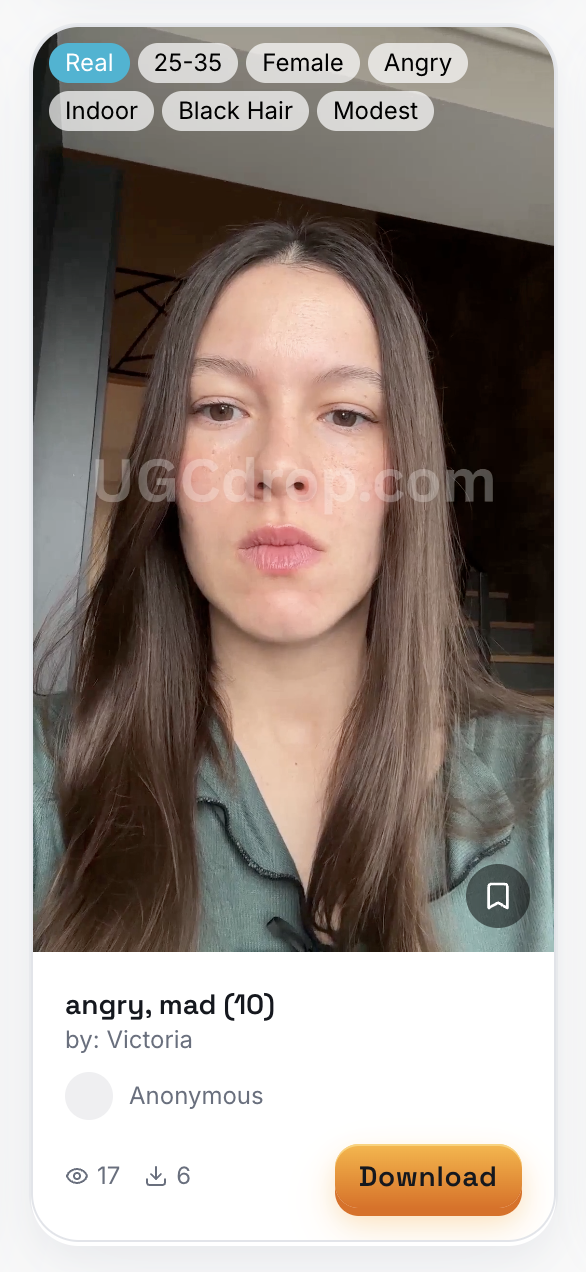
Source your hook clips in minutes, not weeks.
UGCDrop's 100,000+ real human clip library is searchable by emotion and demographic. Find the exact reaction or expression you need for your next hook test — and download it for $0.96.
Browse the Hook Library Free