Travel UGC (2026): How to Start and Get Paid
Travel UGC is short, phone-shot content about trips, hotels and travel products that a creator films and a brand then posts or runs as an ad. You don't need followers, because the brand publishes it, not you. You need a small portfolio of travel clips, a clear rate card, and a list of hotels, tour operators, travel apps and gear brands to pitch.
TL;DR
What it is: travel content you make for a brand's own channels and ads. You get paid for the footage, not for your audience.
What it pays: roughly $100 to $500 per piece of content, according to Simonas, UGCdrop's founder. Old camera-roll footage sits at the low end. Custom talking-head videos sit at the top.
How to start: film three to five spec pieces at home or on your next trip, put them on one portfolio page, and pitch 10 brands a week.
Fastest first dollar: sell the travel footage already on your phone. Clip buyers like UGCdrop pay for camera-roll clips without a pitch or a brief.
Where UGCdrop fits
UGCdrop is a library of real creator clips that brands license for their ads. That makes it a buyer, not a job board. Two ways it can pay a travel creator:
Sell your camera roll. UGCdrop buys unused clips in bulk. The sell page lists $100 to $300 per bulk deal, paid within 7 days, with no account needed.
Swap clips. If you already make UGC for clients, you can upload unused footage and earn credits to download other creators' clips.
It won't find you hotel collaborations or brand deals. For those, you still pitch. The rest of this guide covers both.
What travel UGC is (and how it differs from influencing)
An influencer gets paid to post to their own audience. A UGC creator gets paid to make content that the brand posts. That one difference changes everything:
| Travel UGC creator | Travel influencer | |
|---|---|---|
| Who posts it | The brand | You |
| Followers needed | None | Usually thousands |
| What you sell | Footage and edited videos | Reach and trust with your audience |
| Typical use | Paid ads, brand TikTok and Reels, website, booking pages | Sponsored posts on your account |
| Pay model | Per piece or per clip, plus extra for ad usage | Per post, often tied to audience size |
| Free trips | Sometimes, for on-site shoots | More common |
So the honest answer to "do I need followers?" is no. A brand cares whether your clip looks real and stops the scroll. Your follower count never shows up in their ad.
What travel brands buy
"Travel" is five different buyers with five different needs. Pick one or two to start.
Hotels, resorts and rentals
They want the stay to look real and reachable: a room reveal from the door, the view from the bed, the breakfast, the pool at golden hour, a "what $180 a night gets you" walkthrough. These are usually on-site shoots, so they often come with a free stay plus a fee, or a free stay instead of a fee when you're starting out.
Tours, activities and destinations
Tour operators and tourism boards want the experience from the guest's eyes: the boat leaving the dock, the first bite at a food tour, a reaction at the viewpoint. First-person and selfie-style clips work best here.
Travel apps and booking tools
This is the buyer most travel creators overlook. Flight trackers, eSIM apps, booking apps, language apps and travel planners all run video ads, and they don't need you to travel at all. Their ads follow one format that Simonas sees win again and again: a real person on camera for two or three seconds, a text hook, then a screen recording of the app. A creator looking stressed at an airport gate, then a screen recording of the app finding a cheaper flight, is a full ad.
For a creator, that means a quick talking-head hook or a reaction shot in a travel setting is often worth more than a perfect drone shot.
Travel gear
Luggage, packing cubes, travel pillows, chargers. These are physical products, so the brand needs your hands on the product: packing, unboxing, the bag in the overhead bin. They ship you the product and pay per video.
Ad libraries and clip buyers
Brands in every niche use travel moments in their ads: someone laughing on a beach, walking through an airport, opening a hotel curtain. Libraries like UGCdrop buy that footage once and license it to many brands. In UGCdrop's library today, filtering for real creators in a travel setting returns 260 clips, and most of them are people, not scenery.
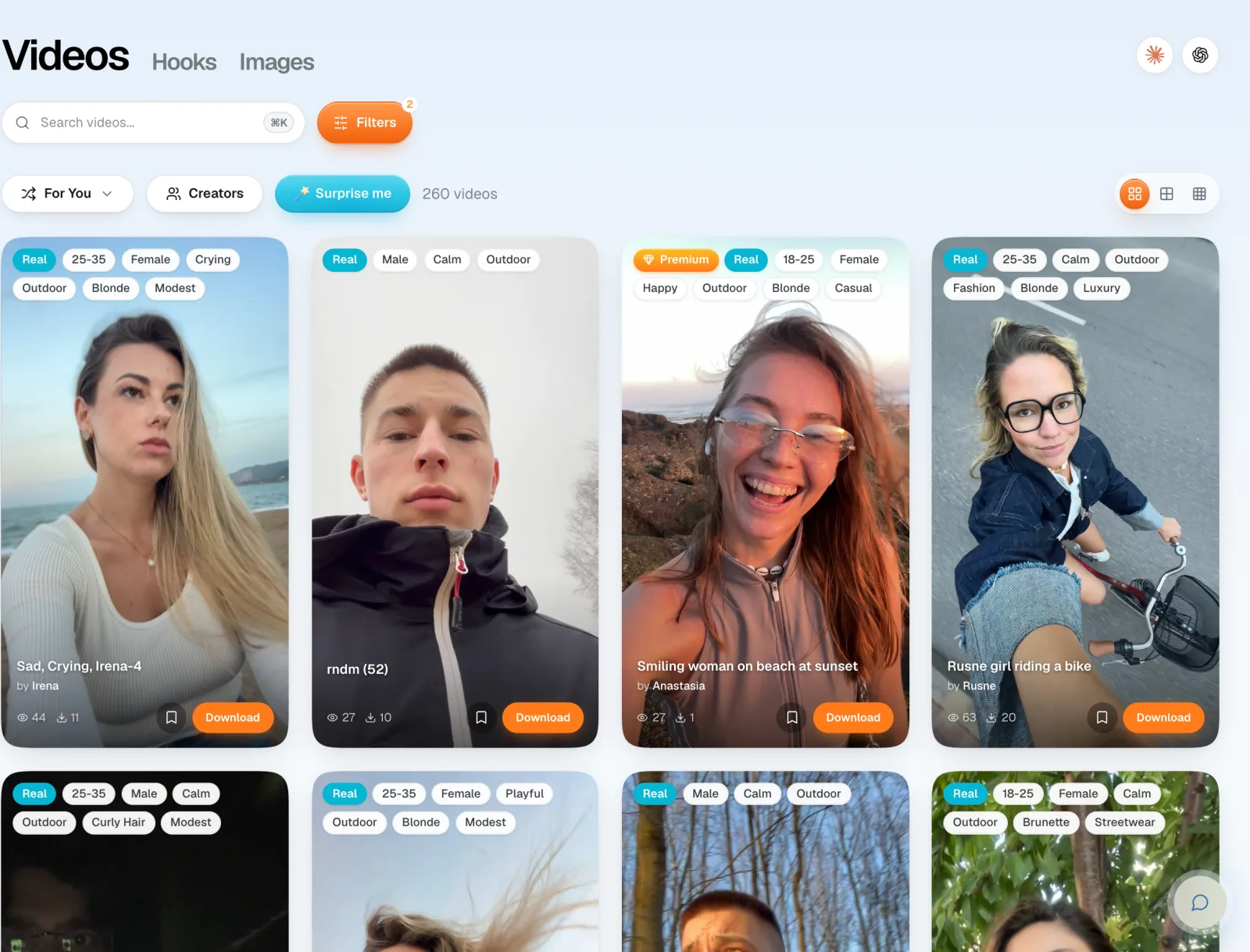
That's the lesson for your portfolio too. A beautiful view is stock footage. A real person reacting to the view is UGC.
How much travel UGC pays
There's no standard rate card, and most guides avoid giving numbers. Here's what Simonas, who has run UGC ads for four years and buys creator footage for UGCdrop, says creators can expect: roughly $100 to $500 for the content you film, quoted either per piece of content or per clip. Where you land depends on how much work the footage takes.
| Tier (cheapest to most expensive) | What it is | Why it's priced that way |
|---|---|---|
| 1. Camera-roll footage | Clips you already have: last summer's beach day, the airport walk, the hotel balcony | Not custom-filmed, so it's the cheapest. Often sold in bulk. |
| 2. Custom-filmed clips | New footage shot to a brand's brief | You film to order, so it costs more |
| 3. Hard-to-film custom clips | Specific scenes that take setup: a certain location, time of day, or action | More time, more retakes, sometimes travel |
| 4. Talking head | You on camera, speaking to the viewer: a review, a story, a hook | The most expensive. Your face and voice carry the ad. |
Creators can also deliver full edited UGC videos instead of raw clips: a filmed hook, a talking-head section and a demo, cut together. According to Simonas, those are the main formats brands buy.
Three things move your price up inside each tier:
Ad usage. Content a brand runs as a paid ad is worth more than a post on their organic feed. Many creators quote organic use and paid ad use separately, and price time limits (30, 60, 90 days).
Raw files. Handing over unedited footage lets the brand cut many ads from one shoot. Charge for it.
Exclusivity. If a hotel group doesn't want you working with competitors, that limits your income. Price it.
Gifted stays are common for hotel work, especially early on. A free night is fine for your first one or two portfolio pieces. After that, a stay is a cost of the shoot, not your fee. For more on pricing structures, see our guide to UGC rate models.
How to build a travel UGC portfolio (without a trip)
You don't need to be in Bali. You need proof you can make a brand's product look real. Make three to five spec pieces, meaning unpaid samples for brands you'd like to work with.
A hotel or rental reveal. Film your next stay, even a cheap one, from the door to the view. Natural light, steady hands, 15 to 30 seconds.
A travel app ad. Pick an app you use. Film a three-second hook at home ("I almost paid $400 more for this flight"), then screen-record the app. This shows you understand ads, not just pretty footage.
A gear video. Pack a bag with a product you own. Hands only, top-down. Shows you can do product work.
A talking-head review. 30 seconds on a place or product, filmed selfie-style. Your highest-paid format, so show it.
A B-roll reel. 10 short clips from your camera roll: airports, walking, coffee, windows, waves. This is your proof for clip buyers.
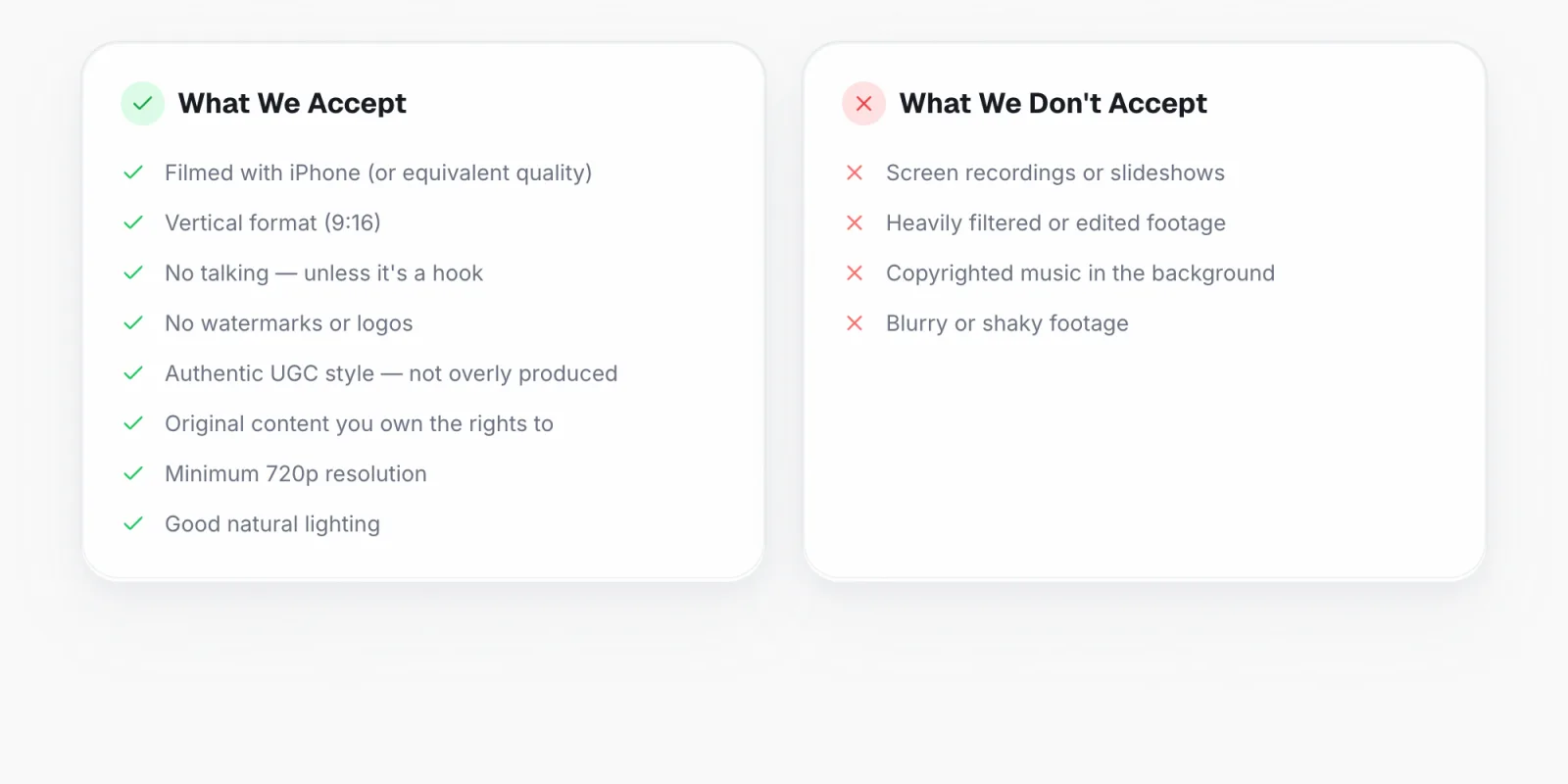
Film vertical (9:16), in natural light, with no filters and no music you don't own. Those are also the rules most clip buyers use. Here are UGCdrop's, from its sell page:
Put everything on one page: a free site, a Notion page or a Google Drive folder with a short intro, your rates (or "rates from $X"), and a contact email. Group videos by buyer type so a hotel sees hotel work first.
How to pitch hotels, tours and travel apps
Pitch small and specific. A boutique hotel, a local tour company or a young travel app replies more often than a global chain.
Find the right person. Marketing manager or social media manager on LinkedIn or the brand's website. For small hotels, the owner or general manager.
Watch their ads first. Search the brand in the Meta Ad Library. If they're already running video ads, they're already buying content.
Send one sample made for them. A 15-second spec video with their app on screen, or their property in frame, beats any portfolio link.
A short pitch that works:
Hi [name], I make short travel videos for brands to use in their ads and on their socials. I noticed you're running [type of] ads on Instagram. I made a quick sample for [brand] here: [link]. I'm staying in [city] on [dates] and could film a room reveal, a guest-view walkthrough and three hook clips for your ads. Rates start at $[X]. Want me to send options?
Follow up once after five days. Then move on. Ten pitches a week is a realistic pace for a beginner.
When pitching brands is enough, and when to sell clips
Pitching is the right path if you want ongoing clients, paid stays, and the higher end of the rate range. It's slower. Your first paid deal can take weeks of pitches.
Selling clips is the right path if you already have travel footage sitting on your phone and want money this week. You don't negotiate, write briefs or wait on approvals. The trade-off is price: camera-roll footage is the cheapest tier, and when you sell clips outright to a library, you usually hand over the usage rights. UGCdrop's sell page says so directly, and also allows clips you've already posted on social media, as long as you own them and they aren't under an exclusive contract.
Most working creators do both. Clips pay for the gear. Clients pay the rent.
How to sell your travel footage to UGCdrop
Pick your best 20 or more clips. People in travel settings beat pure scenery. Think walking through an airport, laughing on a beach, opening hotel curtains, riding a bike through a city, reacting to a view.
Check the rules. Vertical, at least 720p, natural light, no watermarks, no filters, no copyrighted music. No talking unless it's a hook.
Put them in one folder. Google Drive or Dropbox, shared with a link.
Submit on the sell page. Add your name, email, clip style, number of clips and asking price. No account needed.
Wait for the review. The team replies within 48 hours. If you agree on a price, payment comes within 7 days by PayPal, bank transfer or a similar method.
Not every clip gets accepted. Common reasons for rejection are poor lighting, the wrong format, or footage that doesn't match what the library needs right now.
If you're a travel brand reading this
Most "travel UGC" searchers are creators. If you're the brand, the short version: hire creators for on-site hotel and tour shoots, because nobody else can film your property. For ad hooks and reactions, a licensed library is faster and cheaper. UGCdrop has 3,600+ real creator clips from $0.50 per clip, including the travel-setting clips above. It works best for travel apps and booking tools, where a creator hook plus a screen demo is the whole ad. Browse the clips or see UGC stock videos for how buyers use them.
FAQ
What is travel UGC?
Travel UGC is content about trips, stays and travel products, filmed by a creator in a casual, phone-shot style, that a travel brand uses on its own channels and in its ads.
Do I need followers to become a travel UGC creator?
No. Brands post UGC on their own accounts or run it as ads, so your follower count doesn't matter. Your portfolio does.
How much do travel UGC creators make?
Roughly $100 to $500 per piece of content or per clip, depending on the work, according to UGCdrop's founder. Camera-roll footage pays least and custom talking-head videos pay most. Paid ad usage and raw files usually cost extra.
Can you really make money doing UGC?
Yes, but income is uneven at the start. Many creators begin with gifted stays or low-paid jobs while they build a portfolio. Selling existing clips to libraries is a way to earn while you pitch.
How do I become a travel content creator with no experience?
Film three to five spec pieces: a hotel reveal, a travel app ad, a gear video, a talking-head review and a B-roll reel. Put them on one page and pitch small hotels, tour companies and travel apps.
Do I get free trips as a travel UGC creator?
Sometimes. Hotels and tour operators often cover the stay or experience for on-site shoots. Travel apps and gear brands usually don't, because you can film for them at home.
Can I sell travel videos I've already posted?
Often yes. UGCdrop, for example, accepts previously posted clips as long as you own the full rights and they aren't under an exclusive contract. Note that selling to a library usually transfers the usage rights.
Bottom line
Travel UGC pays for footage, not followers. Start with what's on your phone, make a few spec pieces for the buyers you want (hotels, tours, travel apps or gear), and pitch small brands every week. Expect roughly $100 to $500 per piece, with talking-head work at the top. Travel apps are the most overlooked buyer: they need a real face and a hook, not a plane ticket.
Sell your travel clips to UGCdrop · Swap clips with other creators · How brands find UGC creators